Let’s be honest with ourselves for a second.
We treat fertilizer like the hero of African agriculture. Governments subsidize it. Development agencies ship it. Farmers queue for it. And when global prices spike, headlines scream about a “fertilizer crisis” threatening food security.
But here’s the uncomfortable question: Are we asking the right question?
Because if urea were truly the key to food security in Africa, why is the continent still hungry?
Africa uses the least fertilizer in the world, just 22 kg per hectare in sub-Saharan Africa, compared to a global average of 146 kg and Asia’s 130-140 kg. Cereal yields in the region are only 40% of global averages. Meanwhile, Africa imports roughly 90% of its mineral fertilizers, exposing farmers to every geopolitical shock, every shipping disruption, every price spike from halfway around the world.
So, we have a paradox: Africa needs more urea fertilizer, but simply adding more has never worked. Why?
Let’s interrogate this.
The Case for Urea fertilizer: It’s the Foundation
Start with the biology. You cannot argue with the math.
• Nitrogen is yield. Without synthetic nitrogen, half the world’s population wouldn’t be alive. That math doesn’t change in Africa.
• African soils are depleted. Decades of nutrient mining, growing crops without replenishing what they take have left soils exhausted. Over 65% of sub-Saharan Africa’s soil is biologically depleted and chemically exhausted. You can’t grow maize in dust.
• Urea fertilizer is the workhorse. Nitrogen accounts for 63% of total fertilizer consumption in Africa, and urea is the most widely used nitrogen product on the continent. When we talk about fertilizer in Africa, we are mostly talking about Urea.
Case closed, right? More urea fertilizer = more food.
But if that were true, we wouldn’t have a hunger crisis right now, when Africa imports 30 million tons of fertilizer annually.
The Case Against: It’s Not That Simple
Here is where the story gets messy.
• The Dependency Trap: Africa imports roughly 90% of its fertilizer. That means when the Strait of Hormuz is disrupted about 30% of global fertilizer supply passes through it, African farmers pay the price. Malawi gets 57% of its fertilizer from the Gulf region, followed by Namibia (53%), Uganda (51%), South Africa (51%), and Kenya (38%).Malick Niang, a member of the West African Fertilizer Association(WAFA) board, put it bluntly: “Even a very small price increase can lead to a reduction in use and therefore an immediate impact on yields”.For a smallholder farmer living on less than $2 a day, that’s not an inconvenience. That’s a lost season. That’s hunger.
• The Efficiency Problem: Traditional urea surface application in African rice paddies achieves only 25% to 40% nitrogen use efficiency. In the Senegal River Valley, rice cultivation typically applies 250-300 kg/ha of conventional urea, but nitrogen recovery never exceeds 30%. Think about that. For every bag of urea fertilizer a farmer buys, 60% to 75% of the nitrogen never reaches the crop. It volatilizes into the air or washes into rivers. The farmer paid for it. The crop didn’t get it. We are essentially asking farmers to buy fertilizer, apply it badly, and hope for the best. That’s not a food security strategy. That’s a subsidy for inefficiency.
• The Systems Problem: A bag of urea is not an agricultural system.Smallholder farmers manage 80% of Africa’s farmland. A farmer can double her maize harvest and still be worse off if there’s no affordable credit, the road to market is impassable, storage is inadequate, and increased local production causes prices to collapse. This is the lesson of four decades of intervention in Africa. Improved seeds, fertilizer, and better agronomy have repeatedly produced yield gains on individual farms. But there has been no continent-wide transformation.
Why? Because fixing only one link achieves little.
A farmer borrowing to buy urea fertilizer is not just making an investment is alsobetting on the weather. Much of African food production remains rain-fed. If the rains fail, the harvest disappears but the debt does not. What is sometimes called farmers’ resistance to technology is often rational risk management.
The third option: It’s Not “More Urea”. It’s “Smarter Urea”.
If we stop treating this as a binary, more fertilizer vs. no fertilizer we arrive at a more interesting conclusion.
What if urea fertilizer is the key, but we’ve been using the wrong keyhole?
Urea Deep Placement (UDP)
This is not theory. This is proven technology.
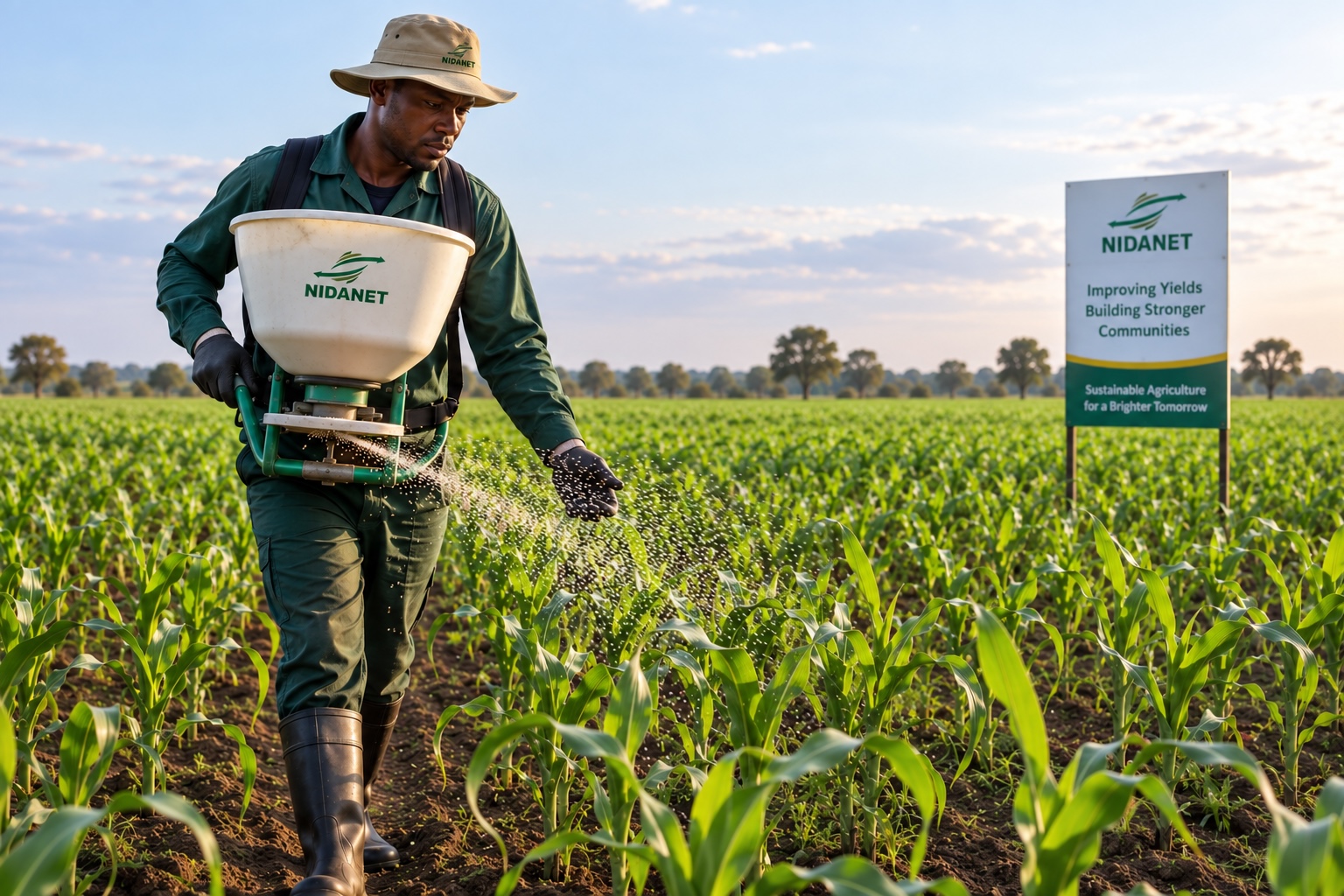
Instead of broadcasting urea across a field where most of it is lost, UDP places larger urea granules 7 to 14 centimeters deep into the soil, directly in the root zone.
The results are striking:
• Nitrogen use efficiency rises significantly from 25-40% to much higher levels
• Yields increase while total urea use stays the same or drops.
• Labor decreases, one application per season instead of multiple.
• Drought resilience improves, roots grow deeper toward the placed urea
• Emissions fall, less ammonia volatilization, less nitrous oxide.
In Guinea, farmer Ataoulaye Diallo reported: “In the past, we used to apply a lot of urea without increasing yields. With deep placement, I noticed the plants remained greener and stronger, even weeks later.”
The TAAT (Technologies for African Agricultural Transformation) program is now scaling UDP across seven countries in the East African Community, with a target of training 3 million farmers, half of them women. So far, 149,940 lead farmers and extension agents have been trained, with a budget of $13.14 million for 2024-2027.
Getting Urea to the Last Mile
The problem isn’t just how farmers use urea. It’s whether they can get it at all. The African Fertilizer Financing Mechanism (AFFM) extended a $2 million partial trade credit guarantee to Apollo Agriculture to distribute over 7,000 tons of urea fertilizer to approximately 100,000 smallholder farmers in Kenya, 50% of them women.
In Nigeria, the federal government launched the “Renewed Hope Smallholder Support and Value Chain Fund,” targeting over 10 million bags of fertilizer to 2 million smallholder farmers through 20 farmer aggregation companies across more than 20 states, with over one-third of beneficiaries being women. Each beneficiary receives a package containing improved seeds, 2-3 bags of fertilizer, and about 20 liters of agrochemicals. These are not perfect programs. But they recognize something crucial: food security is not about the existence of urea. It’s about access to it.
The Honest Limitation: Urea Isn’t Everything
We need to be clear about what urea can and cannot do.
Urea solves the nitrogen problem. It does not solve the phosphorus problem the “P” in NPK (Nitrogen, Phosphorus, Potassium) comes from mined rock, and global reserves are concentrated in just a few countries. It does not solve the soil healthproblem, sub-Saharan African soils often suffer from multiple nutrient deficiencies simultaneously, and focusing solely on NPK can exacerbate limitations in sulfur, zinc, and other micronutrients.
For a urea supplier, the most honest position is this: Urea is necessary, it is not sufficient.
The Final Verdict
So, is fertilizer the key to food security in Africa?
Yes, but only if we turn it differently.
It is not a magic wand. It is a lever. And we have been pulling that lever with our eyes closed, using brute force. The true key to food security in Africa isn’t urea itself. It’s efficiency, access and systems.
It’s the ability to put the right nutrient, in the right place, at the right time, at a price the farmer can afford, without destroying the soil for the next generation.
If we keep treating urea as a crutch for broken systems, we are doomed. But if we use it as a strategic tool, combined with deep placement, credit access, extension services, and market linkages, then yes, it is the key, but only if we are brave enough to admit we’ve been using it wrongly.
NIDANET: Strengthening Africa’s Fertilizer Security
At NIDANET, we are one of the leading suppliers of urea fertilizer in Nigeria and across Africa. Our mission is to reduce the continent’s dependence on fertilizer imports from other regions, a reliance that leaves African agriculture vulnerable to global supply chain disruptions.
A striking example is the Strait of Hormuz, through which approximately 30% of the world’s fertilizer passes. Any closure or disruption of this critical maritime route would trigger a sharp increase in fertilizer prices, with a direct and damaging knock-on effect on food prices across the continent.