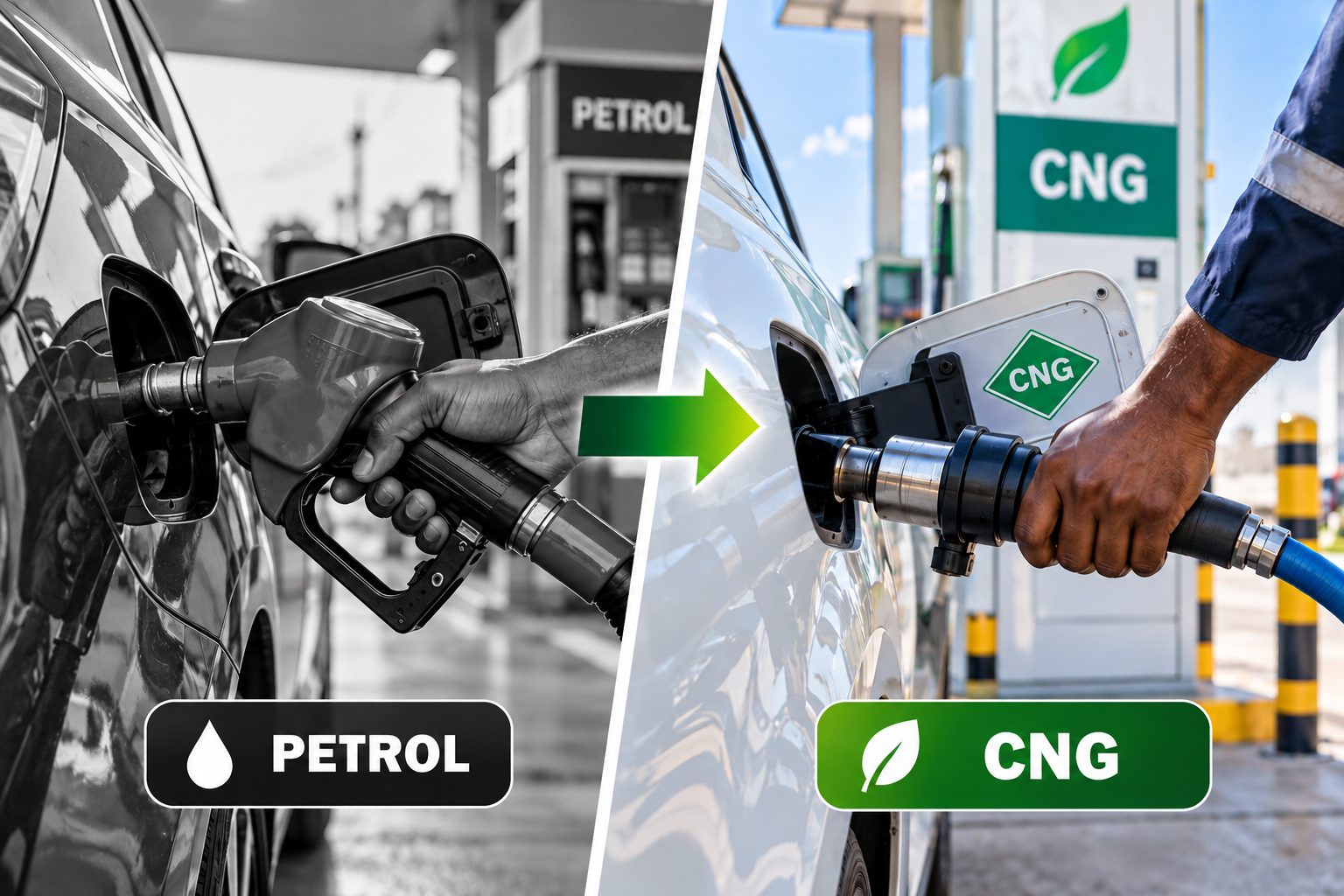
The Genesis: A Policy Born from Crisis
When President Bola Tinubu announced the end of fuel subsidies on May 29, 2023, the immediate consequence was a dramatic spike in petrol and diesel prices and transportation costs. The government’s response was swift: on August 18, 2023, the Presidential Compressed Natural Gas Initiative (PCNGI) was formally approved, targeting over 11,500 new CNG-enabled vehicles and 55,000 conversion kits for existing petrol and diesel-powered vehicles.
The economics sounded compelling. In August 2023, the presidency projected CNG at about ₦250 per litre, compared with petrol at ₦680 per litre and diesel at an average of ₦854.32 per litre at the time. The theory was elegant: remove the subsidy, introduce cheaper CNG, convert vehicles, reduce transport costs, and tame inflation.
Three years later, the theory has collided with a far more complicated reality.
The Economics: Cheaper Fuel, Costlier Conversion
There is no disputing the raw economics of CNG. Commercial drivers who have made the switch report spending more than 75 per cent less on CNG than petrol and diesel users. While petrol sells for between ₦1,250 and ₦1,310 per litre, CNG (for petrol powered vehicle) costs about ₦380 per Standard Cubi Meter (SCM) and diesel sells for between ₦1,729 to ₦1,899, CNG (for diesel powered vehicle) costs about ₦450 per SCM
The problem lies not in the fuel itself but in the gateway to it. Converting a petrol and diesel-powered vehicle to CNG can cost between ₦900,000 and ₦1.6 million, depending on the engine type and vehicle. By September 2026, conversion costs had hit ₦1.1 million, even as NIPCO (Nigerian Independent Petroleum Company) a leading integrated downstream oil, gas, and energy company opened stations across 24 states.
For the average Nigerian motorist, that upfront cost is prohibitive. The Presidential Initiative on CNG and Electric Vehicles (Pi-CNG & EV) has signed agreements with financing partners to offer pay-later schemes with interest rates of 9 to 20 per cent, but as BusinessDay, a premier daily business and financial newspaper and multi-platform media organization in West Africa reported, “affordable financing is not yet available to the average driver”.
The Infrastructure Gap: A Chicken-and-Egg Problem
The fundamental dilemma was perhaps best articulated by Ismaeel Ahmed, Executive Chairman of the Presidential Initiative on Compressed Natural Gas and Electric Vehicles. “It is a chicken and egg,” he admitted. “Am I going to convert my car when there is no gas station? Am I going to invest in a gas station when there are no converted vehicles for them to do the activity?”
The government’s answer was to create demand first. More than 120,000 vehicles have now been converted to CNG nationwide, with over 60 per cent of another 100,000 conversion kits deployed. But the supply side has struggled to keep pace. Currently, Nigeria has about 91 CNG refuelling stations and 300+ active conversion centres across the country, a significant gap between projections and current coverage. Yet for a country of over 210 million people, that is a drop in the ocean.
The consequences are predictable. In Abuja, motorists begin queuing as early as 4 a.m.; by 9 a.m., queues stretch for more than a kilometre. Some stations ration the little gas available; others simply tell motorists to return another day. In Lagos, a tricycle operator spends an average of three hours in the queue each time he needs to refuel. “Imagine having to waste about six hours queuing for CNG in a week,” he says. “That is a huge loss and a threat to revenue”.
The Human Cost: When Savings Are Eaten by Time
For commercial drivers, the economics of CNG are not just about the pump price. Time spent waiting to refuel represents lost trips, lost income, and in some cases, lost livelihoods.
The scarcity is not always about the number of stations. Operators point to supply chain disruptions, such as maintenance work at the Ajaokuta CNG facility in Kogi State, one of the key supply hubs serving Abuja, that ripple across the entire distribution network. In Lagos and other major cities, the queues are primarily the result of limited dispensing stations and inadequate supporting infrastructure, rather than a shortage of gas itself.
The Policy Dilemma: Spending Without Results
A review of federal spending records reveals a troubling pattern. Of the more than $2 billion in investment the government says the initiative has mobilized, most is attributed to private capital rather than direct state outlay. Between November 2023 and June 2026, about ₦76.3 billion moved through the Ministry of Finance and other agencies for buses, tricycles, conversion kits, and related contracts. Nearly 74 per cent of that spending some ₦61.6 billion landed in a single 12-month window in 2024, when the government raced to hand out contracts. Spending then collapsed to roughly ₦550 million in 2025, before edging back up to about ₦2.1 billion in the first half of 2026.
Meanwhile, a significant portion of the funds never touched a bus or a cylinder. About ₦4.9 billion, or 6.5 per cent of total spending, flowed to the Federal Inland Revenue Service and the Federal Sub-Treasury as withholding tax, VAT, and stamp duty. A further ₦57.6 million went toward newspaper adverts and television coverage in a single week in May 2024, an outlay roughly equal to what several vendors were paid to deliver 3,000 conversion kits.
FEDERAL GOVERNMENT INTERVENTION
Expanding Refueling Infrastructure
The government is actively addressing the critical shortage of CNG refuelling stations by:
- Commissioning New Stations: In May 2026, President Tinubu commissioned four major CNG infrastructure projects across Lagos, Abuja, and Owerri. These include the Portland Gas CNG Mother Station in Lagos with a daily capacity of 96,000 standard cubic meters and a high-capacity booster station in Abuja capable of serving 900 to 1,000 cars and tricycles daily.
- Building a Nationwide Network: A network of 15 refueling stations is being delivered across Lagos, with a facility at the Federal University of Technology, Owerri (FUTO) also commissioned.
Reducing Conversion Costs & Improving Financing
To tackle the prohibitive upfront cost of conversion, the government has introduced financing schemes and direct incentives.
- Credit Schemes: A
N2.5 billion Credit Access for Light and Mobility (CALM) initiative was launched to provide affordable credit for conversions and kit manufacturing.
- Financing Partnerships: Pi-CNG has signed MoUs (Memorandum of Understandings) with financial institutions like CREDICORP and Moniepoint to offer pay-later schemes. These allow drivers to repay conversion costs over six months at interest rates of 9 to 20 per cent.
- Free Conversions: The Commercial Vehicle Conversion Incentive Program (CV-CIP) provides free conversion (including labour) for union-registered commercial vehicles in major cities.
Ensuring Tangible Benefits for Passengers
The government is taking steps to ensure that the savings from cheaper CNG are passed on to commuters.
- Targeting Lower Fares: President Tinubu has set an October 1, 2026 target for Nigerians to begin benefiting from reduced transport fares due to the CNG transition.
- Federal-State Collaboration: A joint Federal and State committee has been established to implement measures that translate reduced operating costs for commercial operators into cheaper fares for the public.
Strategic Policy Shifts and Investment
The government has also made strategic adjustments to its approach, learning from the initial phase of the initiative.
- Prioritizing Infrastructure: The Pi-CNG 2.0 programme focuses on availability, affordability, and acceptability of CNG technologies, with a stronger emphasis on building reliable gas supply and infrastructure.
- Local Manufacturing: Plans are underway to establish an industrial park in Ajaokuta dedicated to producing CNG components to reduce import dependence and promote domestic value creation.
- Investment Growth: The initiative has attracted over $2 billion in private-sector investments within two years, with a target of $5 billion by 2027. The number of conversion centres has grown from just 7 in 2023 to 300+ active centers, with a target of 3,000 by 2027.
In conclusion, the government’s response has evolved from an initial focus on conversions to a more comprehensive strategy that includes building infrastructure, providing financing, and setting targets to ensure commuters benefit from lower fares. However, the effectiveness of these measures in closing the gap between policy promises and on-the-ground reality remains a key challenge.